
Drones on the Jobsite: Navigating the Legal and Regulatory Framework for Drone Use on California Construction Projects
Drone technology is transforming California construction projects. Deploying it lawfully requires navigating a complex web of federal FAA regulations, California privacy law, agency permitting, federal equipment restrictions, and local ordinances. In this article, we break down key legal and regulatory considerations contractors and owners need to know before putting a drone in the air on their next project.
Marwa K.
5/18/20264 min read
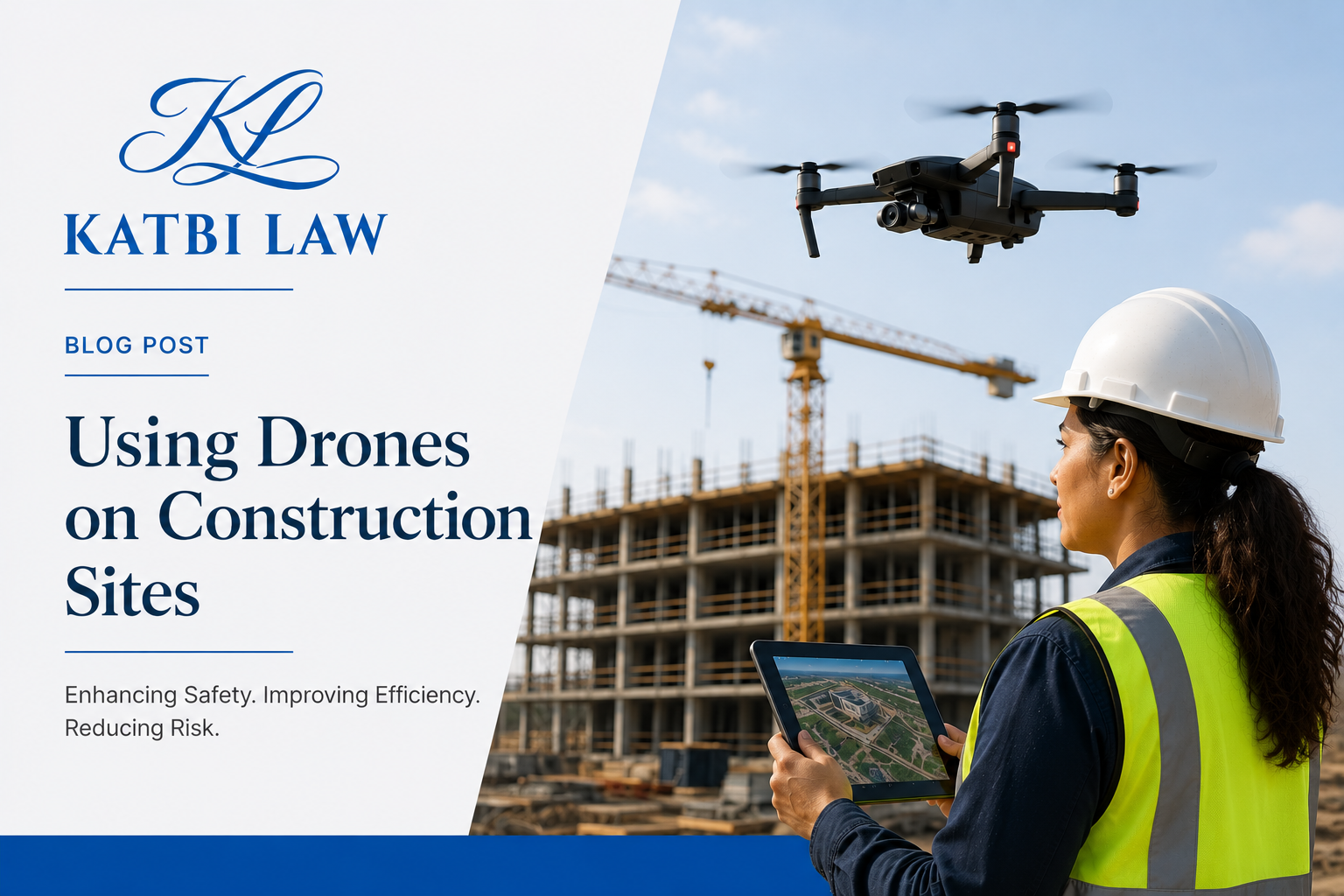

Drone technology has become an indispensable resource on modern construction projects, offering measurable advantages for contractors and owners at every stage of project delivery. Realizing those advantages requires navigating a layered and rapidly evolving legal framework. When deployed lawfully, unmanned aircraft systems advance site documentation, progress tracking, safety monitoring, geospatial surveying, and volumetric measurement. The result is improved outcomes and reduced dispute exposure across the full project lifecycle.
The operational case for drone deployment is broad and well-established across a wide range of construction tasks. Key applications include earthwork calculations, stockpile quantification, slab elevation verification, and pre-bid topographic surveys. LiDAR-equipped systems generate point clouds and digital elevation models, enabling more precise quantity takeoffs, better-informed pricing, and reduced exposure to differing site conditions claims.
Among these applications, drone deployment during pre-bid job walks remains one of the most underutilized in the industry. Aerial surveys conducted during this phase allow contractors to capture topographic data, evaluate access constraints, and document existing site conditions before contract execution, which produces more accurate pricing and reduces differing site conditions exposure. Access for pre-bid drone operations is far from uniform, however. Some public owners expressly authorize aerial surveys as part of the formal job walk; others impose blanket restrictions citing security concerns, airspace limitations, or active site operations. Contractors should not assume that permission to attend a ground-level job walk extends to aerial operations — doing so may expose them to trespass liability or disqualification. Written authorization should be requested before any pre-bid drone deployment, and all proposed operations should be confirmed as compliant with applicable FAA, state, and local requirements. To avoid conferring an unfair competitive advantage, such requests should be submitted through the formal pre-bid question process so that any authorization granted is issued as an addendum available to all prospective bidders.
Beyond the pre-bid phase, productivity gains from use of drone technology are compounded by the risk management advantages that a disciplined aerial survey program provides throughout project execution. On the dispute front, contractors who maintain consistent aerial survey programs are better positioned to substantiate change orders, document pre-existing conditions, and counter inflated claims with objective, timestamped records. This capacity is precisely why aerial documentation is increasingly being mandated in project agreements.
Realizing these benefits lawfully, however, requires careful attention to both state and federal regulatory regimes, starting with California's privacy protections. Cal. Civ. Code 1708.8 prohibits the use of drones to capture visual images, sound recordings, or other impressions of individuals engaged in private activities without consent if the conduct would be offensive to a reasonable person, a provision that may apply to footage incidentally captured on or near active construction sites where individuals have a reasonable expectation of privacy. Contractors deploying drones regularly should adopt internal policies addressing image retention, data ownership, confidentiality, and limits on secondary use of collected information.
Layered on top of California's requirements is a comprehensive federal framework that governs all commercial drone operations nationwide. Key operational limits include a maximum altitude of 400 feet above ground level, visual line-of-sight requirements, and restrictions on flights over people, controlled airspace, and nighttime operations, all of which apply absent specific Federal Aviation Administration ("FAA") authorization. Contractors who use uncertified personnel or exceed these parameters without the requisite waiver or Low Altitude Authorization and Notification Capability authorization face civil penalties and, in willful cases, potential criminal liability. Before mobilizing, contractors should verify personnel certifications, confirm airspace class and any Temporary Flight Restrictions, and document compliance in the project record.
Contractors on publicly funded projects face additional restrictions above the baseline federal requirements. The American Security Drone Act, enacted under the Fiscal Year 2025 National Defense Authorization Act, prohibits use of unmanned aircraft manufactured by covered foreign entities (including DJI and Autel) on federal contracts or federally funded projects. Affected contractors must confirm hardware qualifies under the Department of Defense's ("DoD") Blue UAS Cleared List (the DoD list of approved unmanned aircraft systems that meet security and operational standards for federal use), and should also review any supplementary equipment policies imposed by individual public owners.
In addition to federal equipment restrictions, contractors working on or near California state highways must contend with a separate permitting regime administered by Caltrans. Any drone operation launched from within or flown over State Highway System right-of-way (including interstates, rest areas, and vista points) requires prior authorization. Permits are evaluated case-by-case and are only available for authorized construction or permitted activities; recreational and general business uses are ineligible. Part 107 (the FAA regulation governing commercial drone operations) compliance does not automatically satisfy Caltrans requirements; Caltrans independently reviews applications and may deny or condition approval. Given potential processing delays, contractors should initiate the permit process well in advance and account for lead time in project schedules.
While these regulatory compliance obligations are well-established, project contracts have not always kept pace, which has created gaps that can expose contractors to significant risk. Project documents increasingly assume the availability of drone-generated deliverables without clearly allocating regulatory compliance responsibility - a significant gap when operations cannot lawfully proceed or are delayed. Contractors should ensure agreements expressly address who is responsible for obtaining authorizations, whether drone services are required or optional, data ownership, and how schedule impacts will be allocated when aerial operations are disrupted.
Above these contractual and regulatory challenges, local ordinances add a further and often overlooked layer of compliance that contractors must account for. California municipalities may impose restrictions beyond state and federal law. Some jurisdictions prohibit drone operations over private property without the written consent of the property owner. Others restrict operations within defined distances of critical infrastructure, including utility lines, public buildings, and airports. Contractors engaging in commercial drone operations in certain jurisdictions may also be required to obtain local business licenses and submit flight plans to municipal authorities before commencing operations. As the regulatory landscape continues to evolve, drone use is not merely a technology decision; it is a legal, contractual, and regulatory one. Contractors and owners who address these issues proactively will be best positioned to realize the benefits of aerial technology while managing its risks.
Katbi Law PC is available to advise contractors, owners, and project teams with any questions arising from drone operations on construction projects, including contract drafting and negotiation, regulatory compliance, and data governance policies. If your project involves drone-generated deliverables or you are navigating federal equipment restrictions, airspace authorizations, or related dispute exposure, please contact Katbi Law PC to discuss how we can help.